

How To Repair Loose Soffit
I have "muddled through" many home renovation projects and enjoy sharing my discoveries of how (not) to do information technology yourself.
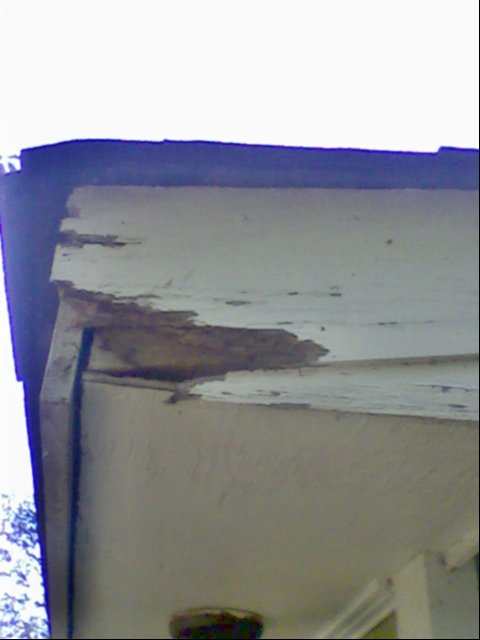
The obligatory "before" picture. The corner of the fascia board has rotted away.
Soffit and Fascia
Eaves are a vulnerable part of your business firm, exposed to weather and damage by falling limbs. Luckily, they aren't too hard to repair when the inevitable happens and repair is needed. And so, if your eaves are wooden, and you have some damage to your fascia lath to deal with, then let'south look at the procedure.
"Fascia?"
That'southward the name for the vertical board or console on the forepart of your eaves. Its complement is the "soffit"—the lath that forms the bottom of the structure—and technically, that's the only part that'south really supposed to be called the "eave."
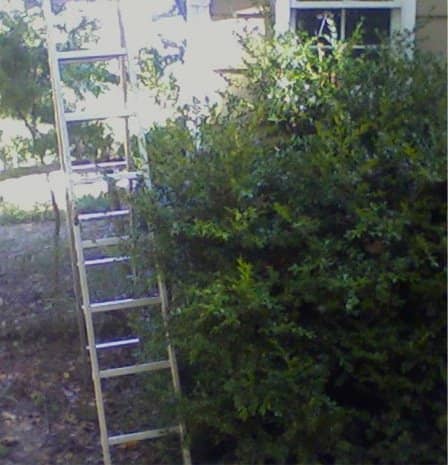
The first thing is getting to the eaves, which ways having to use a ladder. That'southward the unsafe part, especially if the ground where y'all need to work is uneven or sloping. It'due south important to discover or create an even level surface for the ladder; the photos below show what I had to exercise to reach that goal.
How to Repair Fascia Boards
Remove the Impairment
One time you are up the ladder, you lot demand to remove the damaged office of the board. In this example, it was easy considering the damaged section of the lath was already brusque. But if you lot have impairment to a long section of fascia board, you lot may choose to replace just the damaged portion. That'due south non easy, considering the need to protect the roof decking itself makes it hard to make a complete cut across the fascia board. A reciprocating saw—sometimes referred to every bit a "Sawzall"—is probably your all-time option.
Hither, all I had to do was to pry the damaged board away. This job is much easier if you take a good pry bar, such as the one shown below. I was duly grateful.

Pry bar, slightly romanticized.
Fabricate the Replacement Pieces
Once the damaged board is removed, y'all are ready to begin fabricating the replacement pieces. Often that will merely mean the main fascia board itself. The common board in use for this purpose in Due north America is one inch thick past half dozen inches wide (the actual dimensions are smaller).
In this case, though, there was also a thinner triangular slice capping the end of the eave structure. I refer to this—correctly or not—equally a "fillet." It'south made of quarter-inch-thick plywood.

Repair surface area cleared of bad wood and ready to go.
If y'all're replacing a corner piece, the easiest fashion to measure out the bending yous need is to apply the former board every bit a template. You lot can practice this even if, as was the instance in the repair shown, the old board doesn't have a clean, complete border due to the damage suffered. Just use a straightedge to create the directly line you need, as shown beneath.
This raises an interesting question. If y'all look at the closeup of the original lath beneath, y'all can encounter that it was cut with a 45-degree angle edge at the corner. That is the norm for professional person work. That way, in that location is no exposed finish-grain, and the appearance of the corner is as neat equally it tin can possibly exist.
However, for an amateur, achieving a good 45-degree bring together at the corner can be challenging, as it involves cutting angles accurately in two dimensions. If you have the tools and technique, by all means, go for it!
Scroll to Continue
Read More than From Dengarden
Just I chose to avoid this challenge by using barrel joints at the corners, allowing me to use foursquare (90-degree) cuts. That leaves a board with an exposed edge, of course, just by making a clean cut and finishing information technology thoroughly, I hope that vulnerability to weathering won't increase too much. This is perhaps an case of how non to do it—but I don't care if a professional person of xx years snickers at me.
(Past the way, you can run across the 90-caste edge of the previously-replaced fascia board on the adjoining wall in the film above. That was actually the bespeak at which I decided to go with barrel joints.)


Paint, Pigment, Paint!
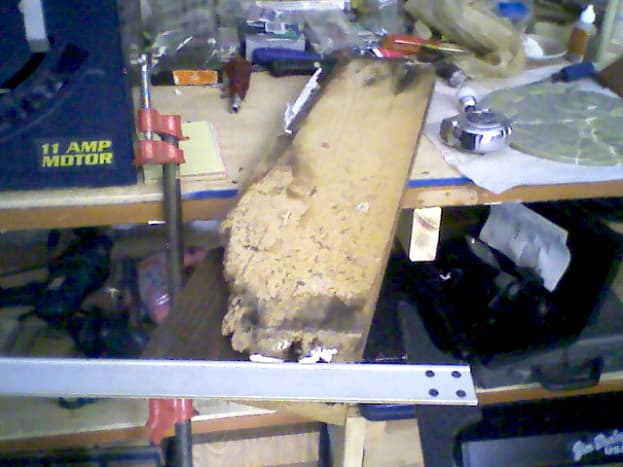
Once the board is cut to fit, paint it. I believe in painting both faces of the board to better protect it from moisture and insects, though contractors will usually but pigment the outside. I use a primer/sealer, such as "Kilz," covering the exterior face merely with a top coat of trim paint.

One area where my piece of work is arguably superior: I paint both surfaces of the replacement board, non just the exposed face. Here the pigment dries, supported on a stepladder.

Here's the fascia board nailed in place, waiting for its finish coat. The scars on the primer coat are small plenty non to be a real problem, and they are about inevitable from the nailing procedure. Damage to paint will be covered with a finish coat
Replace the 'Fillet'
The side by side step is to replace the fillet. You can utilise a piece of cardboard to create a template or design to fill up the space. I actually drew directly on the scrap piece of plywood used for the repair, but that is harder in some ways, as it'due south like shooting fish in a barrel to confuse the orientation of the piece. I ended up with a couple of minor inaccuracies in fit, but decided they weren't enough to justify a second effort.
Paint the piece, as you did for the fascia board, and so install it. Looking at the structure I had led me to two conclusions near the installation. First, I didn't want to pound nails and possibly damage the soffit; and second, I wanted to reinforce the structure of the eave so I wouldn't take to practise another repair later. Reinforcement would likewise brand installation of the fillet much easier.
That reinforcement takes the class of what I telephone call a "batten block." It's merely a piece of 1" x 2," cut to length. It's attached to the soffit board and the backing board with a couple of screws, and information technology gives a solid piece to which the fillet will exist attached in plow. The photos below show the process.
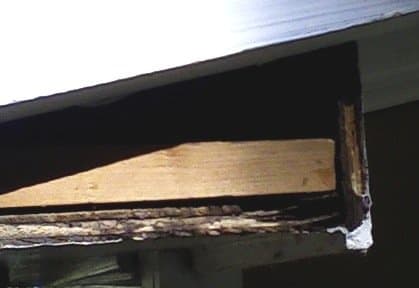

The fillet lath is secured with a couple of finishing screws, as shown below. The inaccuracies are visible in this shut-upwards just won't exist noticeable from the ground when sealed and painted.
Seal Information technology Together
Seal joints with a paintable sealant, both for a smooth finish appearance and to go along moisture out. I used a good-quality latex product.
The close-up beneath shows the joint with the side by side section of fascia, but of course all joints should be sealed—that with the fillet, with the soffit, and at the corner of the eave too. In one case it has dried, yous are prepare to paint!

Use a proficient quality sealant—in this instance I used a latex formulation—to seal the joints and comprehend small imperfections. Brand sure the sealant is paintable!
Finishing Touches
The sealed project is finished with a trim paint—in my case, a gloss white latex enamel. You and I know that there were imperfections along the way. But as y'all can encounter, the project looks good and should final a good many years.
Of course, if I don't want to have to practice more fascia repair, I need to get keen on repainting the "good" fascia and soffit so that they don't deteriorate, as well! And while I'g at it, I'd meliorate remove that disused downpipe you can come across, notwithstanding strapped to the wall at the corner.
Hmm, can that be an article, likewise?
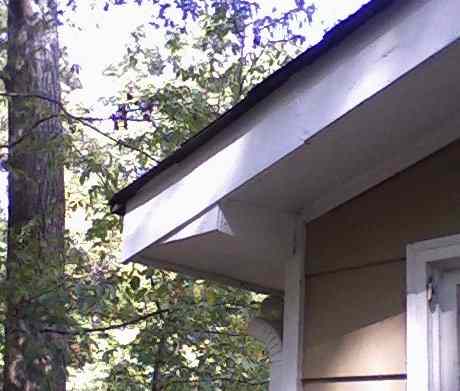
The obligatory "after" moving picture. Sugariness satisfaction!
This article is accurate and true to the all-time of the author's knowledge. Content is for informational or entertainment purposes only and does not substitute for personal counsel or professional communication in business, financial, legal, or technical matters.
Medico Snowfall (author) from Camden, South Carolina on September xix, 2022:
Every bit I recall, information technology was semi. I have read the same as yous--and I'd add together that in that location's a reason people like to use gloss in kitchens!
Ronny on September 19, 2022:
What kind of pigment did you use? Flat, matte, or semi gloss? I know information technology can exist a personal choice for many, but I've as well read that flat paint is harder to make clean.
AJOY ADHIKARI on June 25, 2022:
I don't remember detailing as well much to the customer really helps you. Proceed it brusk & sugariness. You will get better.
Medico Snow (author) from Camden, South Carolina on November 06, 2022:
Sounds like a great tip, thanks! I'one thousand presuming that the W systems filler does expand and contract more similar real wood, then?
Coat on November 06, 2022:
Problem with bondo and other trunk fillers is that they dont aggrandize and contract with the woods during the irresolute seasons. And once it starts bang-up, at that place is the entry point for water and the damage starts all over once more. I also use a liquid epoxy mixed with a filler agent such equally what Due west Systems offers for all the joints and areas that need filler to close the gap. Easily sandable and very potent secure joints that looks seamless for years to come up.
Medico Snow (author) from Camden, Southward Carolina on September 22, 2022:
Thank you for that. I've observed a similar solution in use by some local pros--to fix damaged siding without replacing a board, they applied skillful old Bondo, direct from the car shop, sanded and painted. Completely invisible--and probably a lot more than durable than the board it'due south patching.
Neil on September sixteen, 2022:
Liquid epoxy is a practiced solution to the exposed end grain. I use it even when I accept proper miters.
Doctor Snow (author) from Camden, Due south Carolina on August 25, 2022:
Cheers for the tip, Tim. I know a lot of readers volition appreciate it!
Timthetoolman on Baronial 24, 2022:
Did a soffit repair for the get-go time. FYI - soffit is just ane/viii" plywood with a veneer rolled on. Oh, y'all can actually buy existent soffit but information technology is fabricated of some weird material that you must apply a carbon tipped sawblade to cut. So, to keep things simple -- become with the 1/eight" plywood and purchase a curlicue of the woods veneer. It actually words pretty well.
Doc Snowfall (writer) from Camden, South Carolina on Jan 21, 2022:
Sounds similar a good trick. In that location'south as well a Hardie plank composite lath at present bachelor for soffit. I'thou non sure if they also have something that would exist suitable for fascia. If so, information technology would be 'bombproof' as far equally rot goes, albeit it's a fleck of a pain to work with in some ways.
Coincidentally, this afternoon should see me using a couple of Hardie soffit planks to supercede some deteriorated lap siding. It'south a pretty good match for what's on there--a little thinner than the original, only with a plain finish that seems adequately hard to detect in a 12" lath.
Eugene Brennan from Ireland on January 21, 2022:
Skillful advice, and voted up!
I've had to do this several times, in our climate timber doesn't terminal long unless it'due south hardwood or pressure treated softwood which has been primed, and advisedly painted.
I usually saturate the cut stop of the existing fascia board and all the new section with wood preservative. Considering its so watery, it keeps soaking in and probably prevents any further rot.
Doc Snowfall (author) from Camden, South Carolina on September 27, 2022:
Sure. In fact, y'all'd accept difficulty (I doubtable *not bad* difficulty) sourcing such long boards. But bring together them neatly and they'll expect fine.
TIM on September 26, 2022:
I am replacing a 25 human foot run of fascia board is it ok to employ shorter boards to make it easier to handle?
Dr. Snow (writer) from Camden, Due south Carolina on September 17, 2022:
I'm not sure whether or not I understand your state of affairs correctly. Is your "triangle point" similar to what I'm calling the "fillet?"
If so, I installed the fillet butted to the front of the plywood soffit boards, using a batten block to provide proficient nailing surfaces in each management. That's shown in the fourth-last set of photos.
Just perhaps your question isn't near that? I'll help if I tin can; maybe you would like to electronic mail me a photograph of the pieces you're concerned near? You can exercise that via my Hubpages profile page, if so. Of form yous're also welcome to elaborate hither, if y'all like.
Either way, thanks for your annotate, and good luck with your projection!
ml on September 17, 2022:
The instructions and pictures were very helpful....I was hoping for instruction of the whole board...up to the triangle bespeak, the original 1x6" is non real wood, it has deteriorated (1974 firm) and the eave center triangle piece has pulled away from the 1x6" and is hanging on the heart shelf lath, which was pieced together instead of one long shelf board(probably another reason this trouble happened.) Mainly I'm needing to know if the triangle piece sits backside/in front/or flush up confronting the existing wood triangle frame. I've removed all the (not)wood 1x6 and am fix to replace with real woods, but unsure how to lucifer information technology upwardly and fasten it to the triangle piece that the 2 1x6"'s run across together. thank you if yous canhelp.
Medico Snowfall (writer) from Camden, South Carolina on November 03, 2022:
Y'all're very welcome, nick--I capeesh your comment.
nick on November 03, 2022:
thanks helpful commodity
Physician Snow (writer) from Camden, South Carolina on Oct 14, 2022:
Well, once once more, thanks for stopping by!
Hello, how-do-you-do, from London, UK on October 14, 2022:
I can't answer your questions considering I am non a handyman merely I enjoyed reading you lot hub which was very comprehensive.
Doctor Snow (author) from Camden, South Carolina on October 14, 2022:
So what do you think? Should I have sucked it up and gone for bevelled edges at the corner? Was my ladder technique totally foolhardy? Or--against all odds--did y'all actually learn something useful here?
And how almost your adventures in home repair? Permit united states know. . . we have inquiring minds!

Source: https://dengarden.com/home-improvement/How-Not-To-Fix-Your-Eaves-Fascia
Posted by: pollardsomele.blogspot.com
0 Response to "How To Repair Loose Soffit"
Post a Comment